

As a Product Manager at Brainium, I lead the strategy and execution behind key features that drive engagement, retention, and monetization across our portfolio of mobile games — including Solitaire, Spider, Sudoku, and more. My role sits at the intersection of player experience, business goals, and technical feasibility. I partner cross-functionally with designers, engineers, analysts, and marketers to shape systems and experiences that delight players while supporting long-term growth for the studio.
With a background that spans education, quality assurance, and technical support, I bring a holistic view of the product lifecycle — from ideation and prototyping to A/B testing, live operations, and post-launch optimization. I’ve launched features like the Daily Game Calendar, Curated Games, and new gameplay mechanics such as the Reveal feature, all designed to enhance early player retention, feature discoverability, and overall player satisfaction. Whether defining roadmap priorities or analyzing market trends, I’m driven by a commitment to thoughtful design, collaborative execution, and sustainable product success.
Highlighted Projects
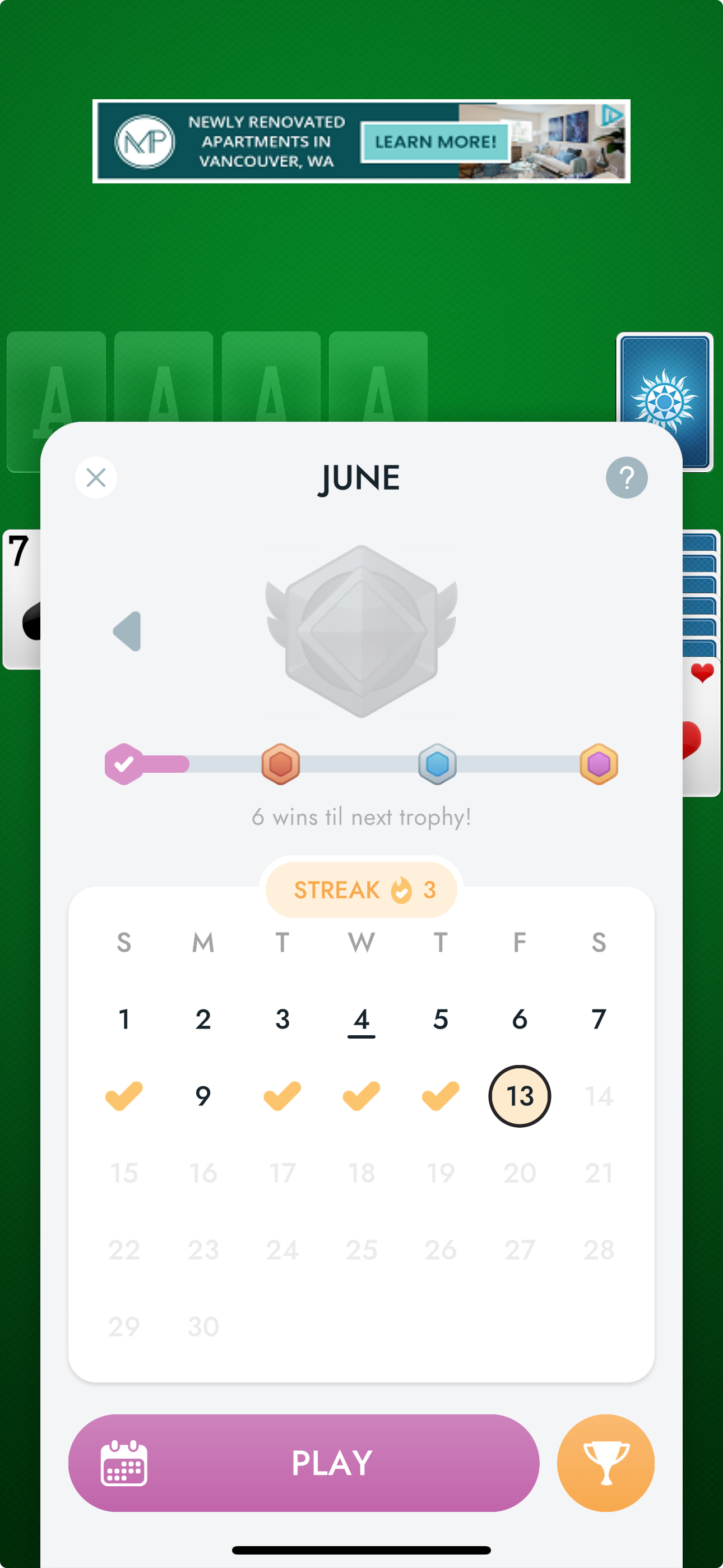
📆 Daily Calendar
To support long-term engagement and incentivize players to return to the app each day, I led the strategic development of the Daily Calendar — a Daily Game mode designed to encourage players to participate in daily Solitaire play. I partnered closely with design, engineering, and business intelligence to shape feature goals, design A/B tests, and determine optimal rewarded video engagement opportunities that aligned with both player motivations and monetization objectives.
We ran multiple A/B tests to evaluate different monetization structures, including variations in rewarded ad placement, as well as player-facing incentives like repairing a broken streak. These experiments informed both the flow and mechanics of the feature, allowing the team to fine-tune the balance between engagement and RV viewing opportunities. After successful testing, the feature was rolled out to the full player base, resulting in measurable increases in Daily Game engagement and the number of Daily Games played per user.


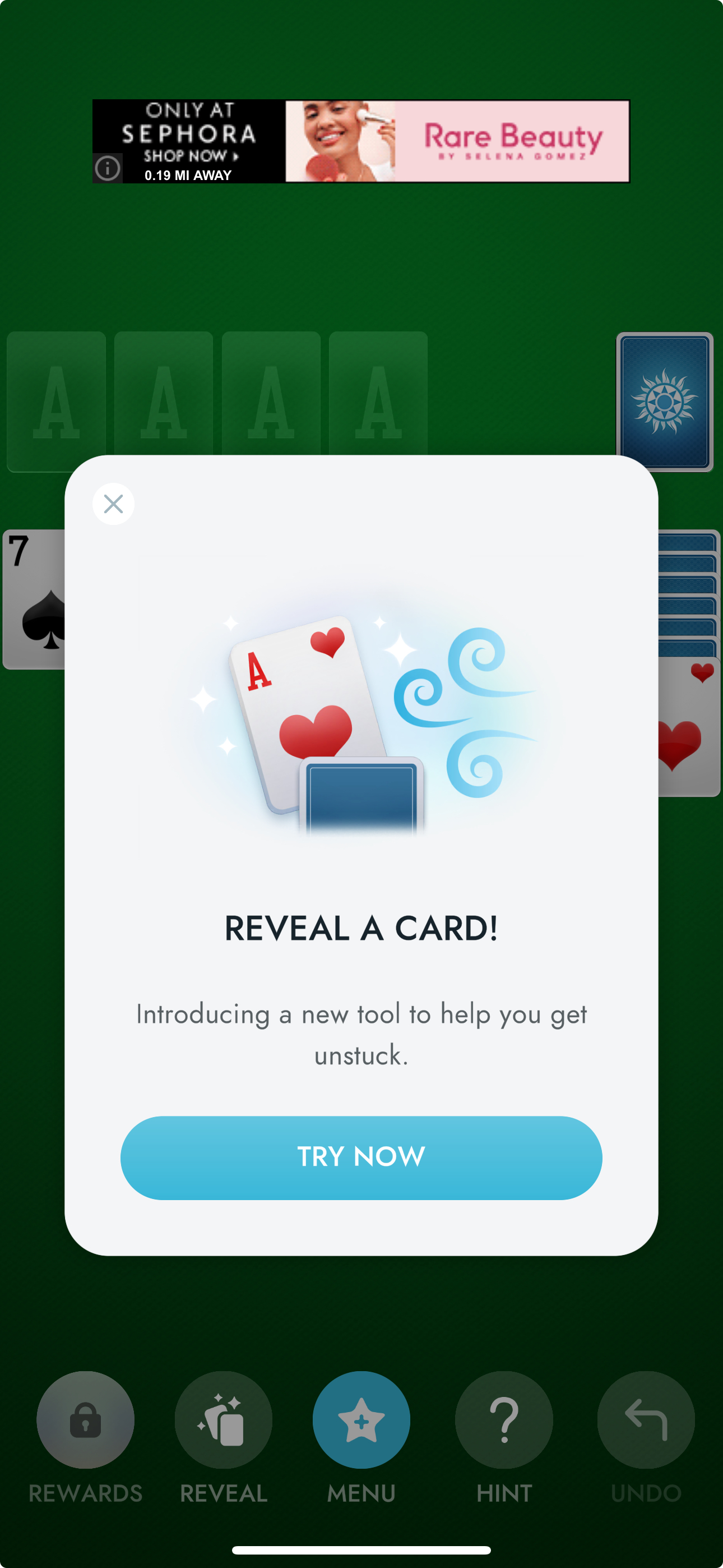
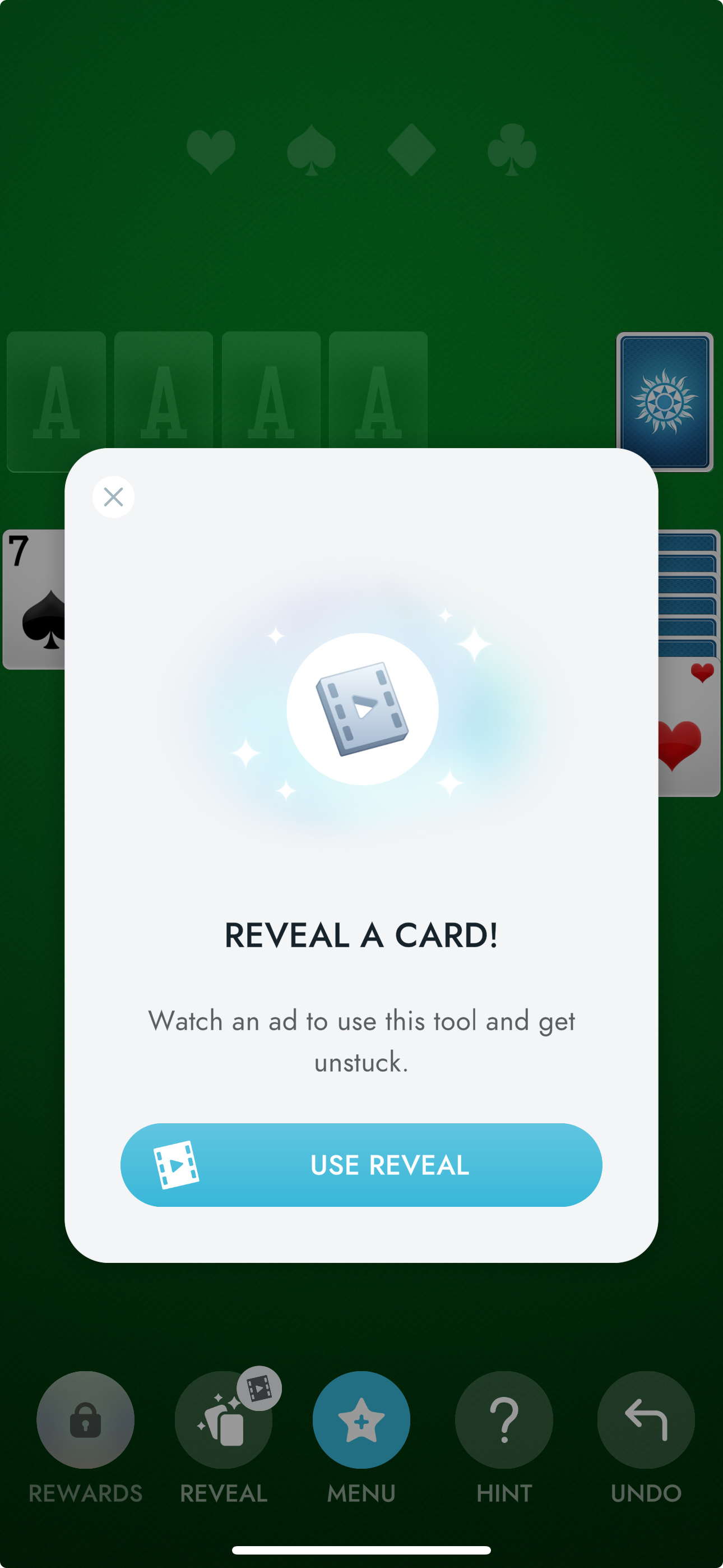
🌬️ Reveal Feature
As part of an effort to enhance the core game loop in Solitaire and integrate rewarded video more meaningfully, I led the product strategy for the Reveal feature — an in-game assist designed to support players during moments of friction while introducing a monetizable mechanic aligned with gameplay. Inspired by similar “Magic Wand” features seen in other casual games, Reveal unveils a helpful card on the board through a wind animation, allowing players to continue a stalled game.
Our goal was to create a system that players would find genuinely useful — not disruptive — and worth engaging with in exchange for watching a rewarded video. Through discovery and competitive research, we identified this mechanic as a strong candidate for increasing both RV engagement and player satisfaction. We hypothesized that by embedding the feature directly into the game board and lightly nudging players towards the feature at moments of need, we could improve session value without compromising player flow.
We launched experiments to test interaction, placement, and quality of reveals (random vs. optimized), while tracking KPIs like RV views, session length, and retention. Initial results showed promising increases in rewarded video views and player continuation rates, validating the approach of integrating helpful, value-driven monetization within the core experience.


🧠 Curated Games
To improve early player retention in Solitaire, I led the strategic development of Curated Games — a system designed to serve players a selection of pre-vetted, winnable game boards during their initial gameplay sessions. Our core hypothesis was that by providing players with a more achievable and satisfying early experience, we could increase the likelihood of continued engagement and return play.
We tested multiple configurations over three experiments. The first introduced a curated set of winnable games, resulting in up to a 2% lift in retention and a notable increase in average win rate from 33% to 55%. The second test evaluated whether structuring those games into a specific progression order could further boost retention, though results showed that ordering had minimal additional impact. In the third phase, we leveraged internal technology to extract and score over 1,000 winnable games with varying win rates, providing a robust library for future testing and iteration.
Following these experiments, we established a default onboarding experience built around 500 curated winnable games and released the feature to all new players on iOS and Android. The initiative demonstrated that surfacing more thoughtfully crafted early experiences can measurably influence player satisfaction and retention without compromising the integrity of gameplay.
⏳ Limited Time Events
To introduce a lightweight progression mechanic and support regular App Store updates, I spearheaded the development and initial testing of Limited Time Events (LTEs) in Solitaire. These events invited players to complete gameplay milestones within a set timeframe to earn exclusive cosmetic rewards like card backs and backdrops.
The primary goal was to bring Brainium’s live ops strategy closer to parity with other top casual titles by offering time-bound content and visible goals. While A/B testing showed no significant impact on DAU or retention, LTEs provided players with something to work toward and enabled consistent feature visibility through App Store Events. Since launching LTEs to a regular monthly cadence, we consistently see store-specific KPIs like page views and installs increase when we run a LTE.

 Chelsea Marie Hicks